Private messages
Talk one to one. Message anyone, one-on-one — Echo can't read it. If you set up recovery, that backup is only as strong as the recovery code and PIN that protect it.
The private messenger for iPhone and Android. No phone number, no email. Free to start.
Free to start. An iPhone beta today; the App Store and Google Play at launch.
It's a fair question, and the answer is plainer than it looks. Messaging costs real money to run. Somebody pays for it. When it isn't you, the arrangement is something else.
Servers, storage, engineers, support, a legal team. All of that costs the same whether you paid a penny or not. Free never meant free to make.
What earns the money isn't the messaging. It's your attention, and a picture of you assembled from what can be watched — who you talk to, how often, where you are, what you're likely to want next. That picture is the thing with a price on it.
Once a company earns by knowing you, every decision after that quietly leans the same way. Not because anyone set out to be sinister. Because that's what pays for the thing you're using.
So how is Echo free? People on Pro and Family pay for it. Nobody pays by being watched.
Being watched became the internet's default setting. We think that's backwards.
Somewhere along the way, "free" started to mean you're the product. Your conversations, mapped. Your relationships, indexed. Your private moments, quietly kept — just in case they're useful later.
Echo takes a different position. Privacy shouldn't be a promise a company can quietly change. It should be structural — the way the walls of your home are structural. Not a setting you switch on. Not a clause in a document. Just how the thing is built.
What you say, who you say it to, the shape of your day — it all came out of you, and it stays yours. Not mined. Not sold. Not ours to take.
What you write turns into a locked block before it leaves your device. What we store is that block. Echo can't read your one-on-one, family or group messages, and doesn't read your Sealed Chats. No setting turns this off, and none of it is for sale. What Echo can see is who you talk to and when: one Echo Key to another, not phone numbers, plus the names you chose. Never what you said. If you set up recovery, that backup is only as strong as the recovery code and PIN that protect it.
No email. No phone number. No password. You pick a name your friends see, and that's the whole sign-up.
You pay us, or you use the free tier. Either way you're the customer — there's no second business quietly running behind this one.
Most apps ask you to trust their privacy policy. We'd rather let you watch. Two phones, a conversation, and everything the network keeps about it, side by side, as it happens. Nothing here is behind a sign-in, because we don't need to know who you are to show you this.
One conversation, two phones. Echo is on iPhone today. Android is coming, built the same way.
Four things per message, and not one of them is a word. The block on the right is the message itself, exactly as we store it. We can keep it and hand it to the right device, and for messages sent since 12 October 2026 (one-on-one) or 25 October 2026 (family chats and groups), we cannot turn it back into language. If you set up recovery, that backup is only as strong as the recovery code and PIN that protect it.
Echo can't read your one-on-one, family or group messages, and doesn't read your Sealed Chats. If you set up recovery, that backup is only as strong as the recovery code and PIN that protect it.
What Echo can see is who you talk to and when: one Echo Key to another, not phone numbers, plus the names you chose. Never what you said. Echo can also see the dates and times on your family calendar. We read the Support chat, because it's addressed to us, and if you report a message, your app sends us a readable copy of it so a person can review it.
The full details, with dates, are in our Privacy Policy →
Privacy you can't inspect is just a nicer promise. We'd rather be judged on how it's built than on what we say about it.
Being straight about this is the point. Delivering a message means knowing a little, and pretending otherwise would be the dishonest version of this page.
Not "won't." These aren't switches we chose to leave off — there's nothing on our side to switch.
Family chats, groups and the family calendar got the same second lock on 25 October 2026, and so does every Sealed Chat set up since then. Anything older, we don't read.
Think about how much of what arrives on a normal day you never asked for — the group you were dropped into, the stranger who somehow has your number, the message that was never meant for you personally. None of that can happen here, and not because we filter it well.
Echo never asks for a phone number or an email, and there is no directory to browse. The only way to reach you is a key or a link you handed to someone yourself.
Someone can ask. Nothing arrives until you say yes — the message is refused outright, not filtered into a folder you'll never open. Decline, and that is the end of it.
You get an invitation, and you are not in the room until you accept. Nobody can put you in a thread full of strangers, because nobody can put you anywhere.
If you post your Echo Key somewhere public, people can ask — that is the one door you can open yourself. They still cannot reach you until you accept, declining takes a tap, and you can hand out a link that expires instead. We would rather tell you where the edge is than pretend there isn't one.
Spam was never really a message problem. It's an address problem — and Echo never gave you one.
Familiar on the surface. Fundamentally different underneath.
Talk one to one. Message anyone, one-on-one — Echo can't read it. If you set up recovery, that backup is only as strong as the recovery code and PIN that protect it.
A private place for the people you'd protect with your life — kept separate from everything else.
Put a one-on-one chat behind a passphrase you choose. It opens with your passphrase, and Echo doesn't have it. Forget it, and what's inside stays closed.
Say it, then let it go. Messages that quietly count down and dissolve — on your terms, on your device.
Everyone in one place, and nobody added without saying yes.
No email. No phone number. No password. You get a random key that's yours alone — a locker number, not a name tag.
No spinning wheels, no "last seen." A living wave on every message you send — it pulses as your words leave, settles when they arrive, and glows a calm cyan when they're read.
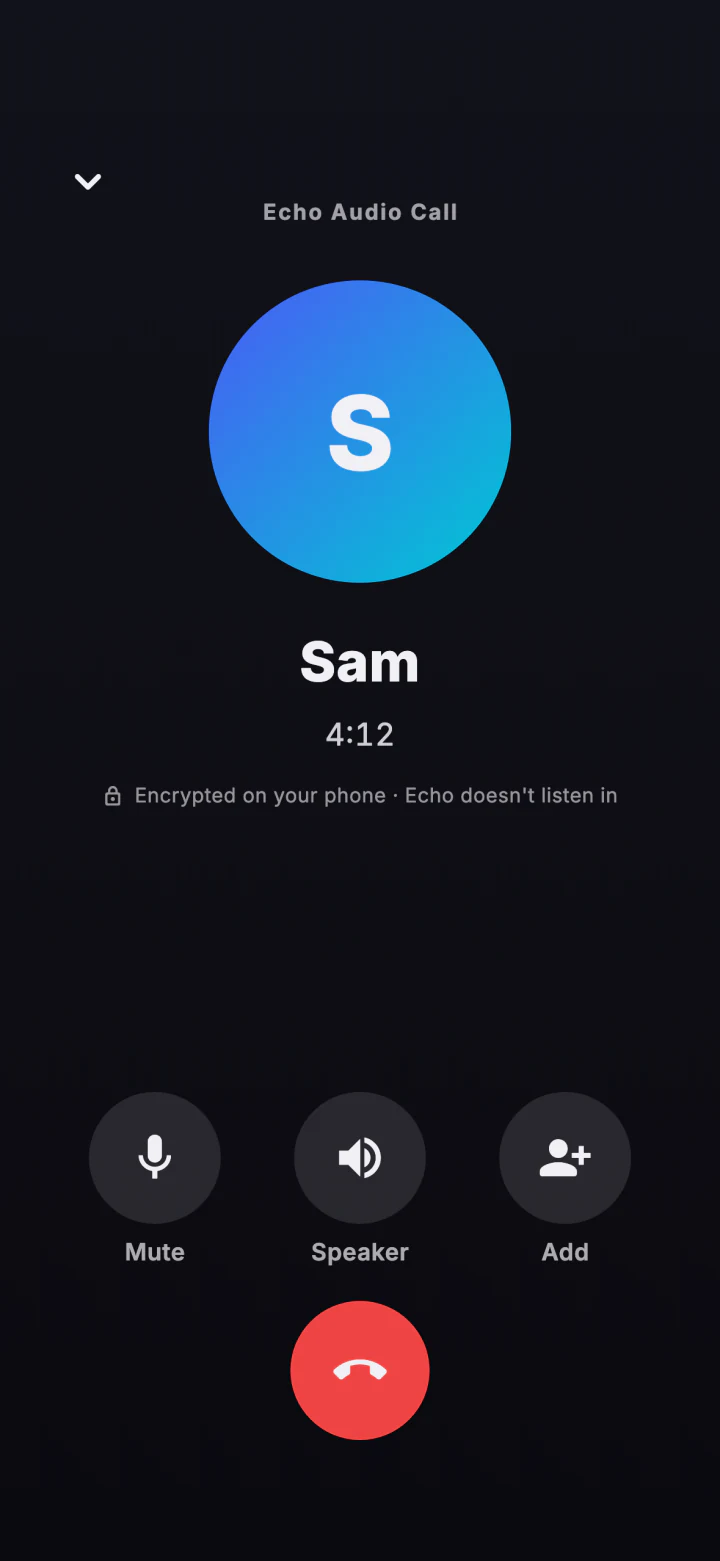
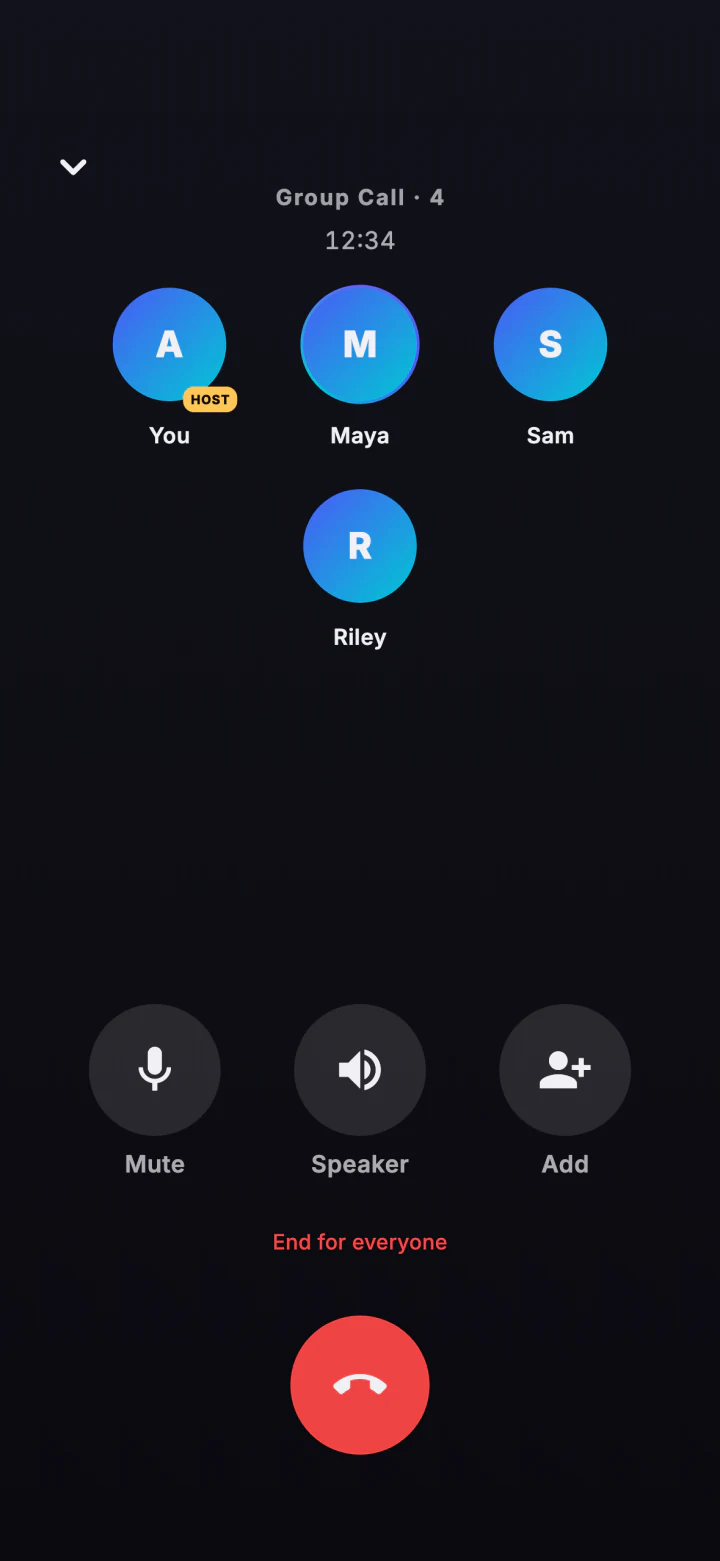
Call one person, or bring a few people into the same call. Voice only, by choice: no camera to check, nothing to tidy behind you. Just the voices you'd ring anyway.
Free on every plan.
Starting one takes Pro or Family. Everyone you invite joins free.
Calls are locked between phones, and Echo doesn't listen.
Like your messages, who calls whom and when isn't hidden from us.
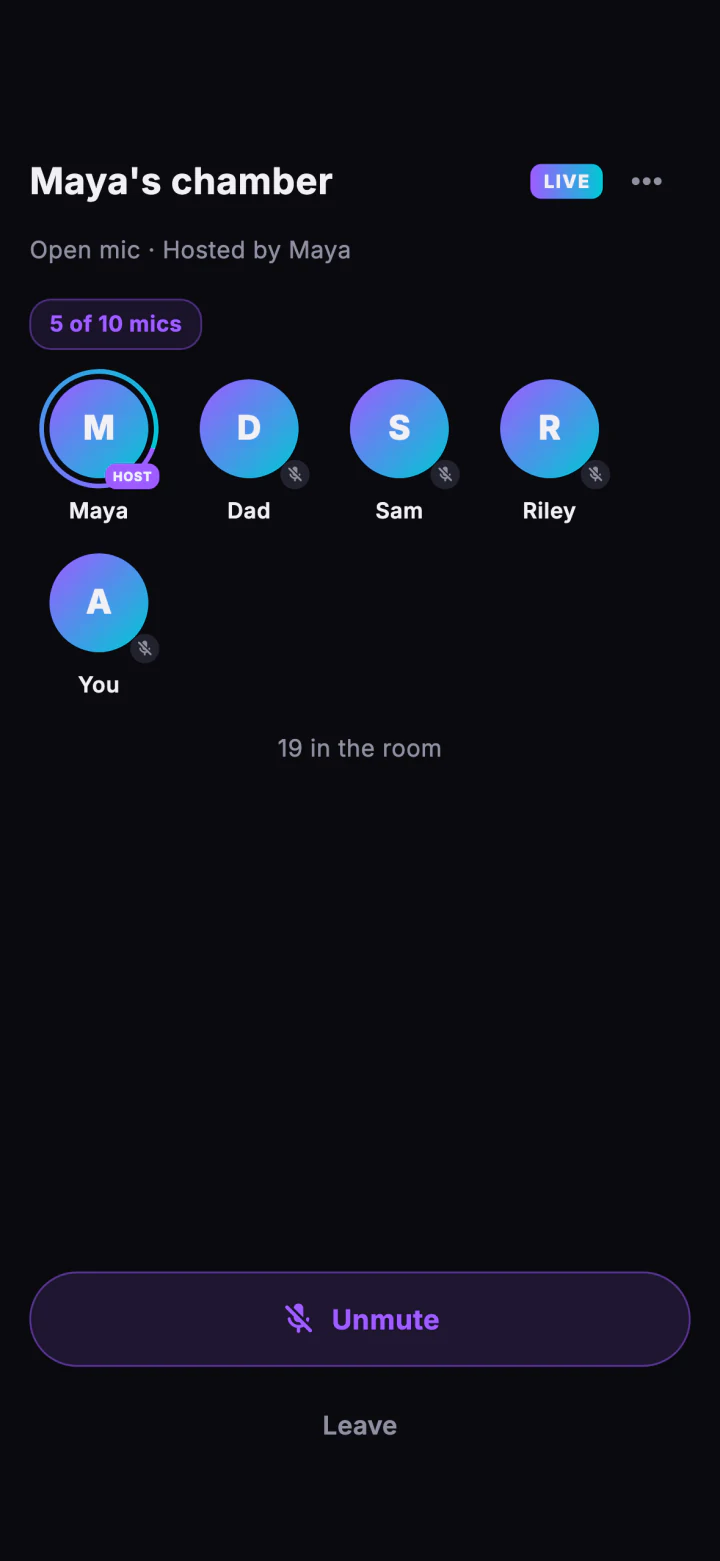
A chamber is a live audio room. A few people talk and everyone else listens, like a panel or a family story night. It's live and then it's over: Echo doesn't record chambers, and there's no replay.
Listeners raise a hand, and the host brings them up. Good for a talk, a Q&A or a big family announcement.
There are 6 mics to start, the host can open up to 10, and everyone starts muted. Good for a group that just wants to hang out. The host can switch modes while the room is live.
What we can see
What Echo can see is who you talk to and when: one Echo Key to another, not phone numbers, plus the names you chose. Never what you said. For calls and chambers: who called whom, when, for how long, and who was in the room. For messages: which groups you're in, when each message was sent, how big it was and whether it was read, plus family-calendar dates and times. We read the Support chat, and we get a readable copy of any message you report.
On iPhone at launch. Chambers comes to Android when Echo launches on Android.
Never the inventory. A few dollars a month, from people who want the thing, pays for the thing. That's the whole business — there is no second one running quietly behind it. Echo is also free to start, and that's paid for the ordinary way: by the people on Pro and Family.
On every plan, including Free, every message, photo and voice note is encrypted on your phone before it's sent, and Echo doesn't read your messages. You can delete any chat, or your whole account, whenever you want. Paid plans add more tools. They never add more privacy.
Everything that makes Echo Echo. No time limit, no ads.
Messaging
Calls
Chambers
Privacy tools
Family Hub
Looks
For one person who wants the full set.
Calls
Chambers
Privacy tools
Family Hub
Looks
You plus 5 people. The people you add pay nothing.
Family Hub
Seats
* Hosting chambers has a daily fair-use limit. Bigger rooms with more open mics use it faster. On Echo Family, everyone you cover shares one daily allowance. If you get close, Echo tells you, and you'll have 15 minutes to wrap up.
† If you set up recovery, that backup is only as strong as the recovery code and PIN that protect it.
Prices are in US dollars for the US App Store, before any sales tax. Elsewhere, the store sets the price in your currency. Your exact price is shown in the app before you pay.
Echo is sold through the App Store. Plans aren't on sale in Google Play yet.
Plans renew automatically until you cancel. Cancel anytime in your App Store subscription settings. No free trial: Free is yours for as long as you like.
No ads. Ever. And no AI reads your messages.
No phone number, no email. Pick a name, and you're in.
Free to start. An iPhone beta today; the App Store and Google Play at launch.